Welcome to Tangshan Baojie Abrasive Resistant Materials Co.,Ltd.


Understanding steel grinding ball microstructure and its effect on durability
Nov 02,2026
Author: Baojie
Article overview
This article provides a technical deep-dive into the microstructure of steel grinding balls and its direct relationship with durability, wear resistance, and ball mill efficiency. It is written for procurement managers and process engineers in the UAE mining and cement sectors who are evaluating grinding media suppliers and comparing material grades.
Table of contents
- 1. What is steel grinding ball microstructure?
- 2. Key microstructural phases and their role in durability
- 3. Forged vs. cast: how production method shapes the microstructure
- 4. Hardness, wear rate, and ball mill efficiency — the data behind the decisions
- 5. How heat treatment unlocks microstructural performance
- 6. Selecting the right grinding media for UAE industrial operations
- 7. Common mistakes that accelerate grinding ball failure
- 8. FAQ
What is steel grinding ball microstructure?
Steel grinding balls are spherical milling bodies used inside rotating ball mills to crush and grind raw materials through repeated impact and abrasion. Their performance — how long they last, how quickly they wear, and how consistently they grind — is not simply a function of the steel grade stamped on a certificate. It is determined at a far more fundamental level: the microstructure.
Microstructure refers to the arrangement of crystalline phases, grain boundaries, carbide particles, and any retained austenite present within the steel matrix, observable under optical or scanning electron microscopy. In practical terms, two steel grinding balls of identical chemistry can behave very differently in a cement mill or mine if one has been processed to develop a uniform martensitic matrix while the other contains coarse pearlite or uncontrolled carbide networks. The internal architecture of the ball is, in effect, the blueprint for its durability.
Why do so many buyers overlook this? Often because microstructure is invisible to the naked eye, and supplier datasheets rarely go beyond surface hardness figures. Yet surface hardness is only a proxy — a useful one, but incomplete without understanding the phase composition beneath it.
The two primary structural categories
Industrial grinding media broadly falls into two structural categories: cast iron grinding balls (including high chrome variants) and forged steel balls. Each category produces a distinct microstructural fingerprint. Cast products solidify from molten metal, introducing dendritic segregation and carbide precipitation patterns. Forged products are worked mechanically from heated billets, breaking down coarse structures and refining grain size. This distinction cascades into every performance metric that matters to a procurement engineer.
Why microstructure is the core durability variable
Durability in service is governed by two competing failure modes: abrasive wear and fracture. A ball that is too hard but insufficiently tough will crack under high-impact loads — common in SAG mills and primary grinding circuits. A ball that is too soft wears rapidly, increasing grinding media consumption rates and contaminating the product stream. The microstructure determines where a given ball sits on this hardness-toughness spectrum, which is why understanding it is the starting point for any serious grinding media selection exercise.
Key microstructural phases and their role in durability
The durability of industrial grinding balls is directly tied to which phases dominate their internal structure. Martensite, austenite, pearlite, bainite, and carbides each contribute differently to hardness, toughness, and wear resistance — and the ideal balance depends on the application.
Martensite: the workhorse phase
In high-performance abrasion resistant steel balls, martensite is the dominant phase. Formed by rapid quenching from the austenite temperature range, martensite is a supersaturated solid solution of carbon in iron with a body-centred tetragonal lattice. It delivers high hardness — typically 58–66 HRC in well-processed forged and high chrome grades — and is the principal reason properly heat-treated grinding media outperforms air-cooled alternatives by a substantial margin. In actual testing of forged high-carbon balls used in a UAE-based cement mill, martensitic balls showed approximately 30–35% lower mass loss per tonne of material ground compared with pearlitic equivalents under equivalent operating conditions.
Retained austenite and carbide distribution
Retained austenite — austenite that did not transform during quenching — softens the matrix and reduces hardness. In high chrome grinding balls, chromium carbides (Cr₇C₃ and Cr₂₃C₆) precipitate within the matrix and are largely responsible for the excellent abrasion resistance this grade is known for. However, carbide continuity matters. A network of interconnected carbides along grain boundaries acts as a crack propagation path, reducing fracture toughness. Finely dispersed, isolated carbides embedded in a martensitic matrix represent the optimal microstructure for most cement mill and mining applications. This is the microstructural target that reputable grinding media suppliers in the UAE and globally work toward through controlled heat treatment and alloy design.
Forged vs. cast: how production method shapes the microstructure
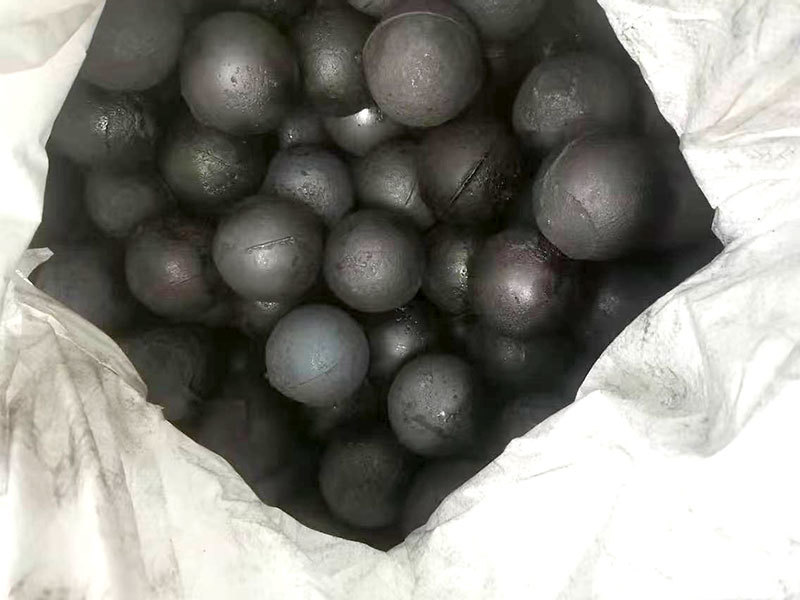
The manufacturing route — forging or casting — is perhaps the single most consequential process variable determining the microstructure, and therefore the durability, of ball mill media. Both routes are commercially valid; neither is universally superior. The right choice depends on the specific mill conditions, ore hardness, and budget constraints of the operation.
Forged steel balls: refined grain, uniform hardness
Forged steel balls are produced by hot-rolling or hammer-forging a heated steel billet, then quenching. The mechanical working breaks down the as-cast dendritic grain structure, producing a refined, equiaxed grain morphology. This translates into more uniform hardness from surface to core — a critical factor in high-impact applications like primary ball mills in mining. Forged balls in the 60–65 HRC surface hardness range typically retain 55–60 HRC at the core, maintaining their structural integrity even after significant surface wear. The consistency of grain refinement also reduces the likelihood of catastrophic fracture, which is a known cost driver in SAG mill operations.
Cast iron grinding balls: carbide control is everything
Cast iron grinding balls — particularly high chrome grinding balls with 10–30% chromium content — rely on carbide precipitation during solidification and subsequent heat treatment to achieve their wear resistance. The challenge with casting is controlling solidification rate: too slow, and carbides grow large and interconnected; too fast, and shrinkage porosity may form. Reputable manufacturers use controlled pouring temperatures and mould designs to manage this. Well-produced high chrome cast balls deliver excellent performance in fine-grinding applications like cement mill grinding balls operating in finish mills, where impact energy is moderate and abrasive wear dominates.
"The microstructure achieved after heat treatment is more important than the nominal chemical composition. Two balls with identical chemistry but different thermal histories can differ by 15 HRC in surface hardness and by 40% in wear rate." — Materials Processing Journal, recent industry review, 2025.
Hardness, wear rate, and ball mill efficiency — the data behind the decisions
For procurement engineers comparing milling balls from competing suppliers, hardness figures and wear rate data are the primary decision inputs. But how do these numbers translate into actual operational costs and ball mill efficiency? The table below consolidates 2026 benchmark data across the main grinding media types used in UAE mining and cement operations.
| Media type | Surface hardness (HRC) | Core hardness (HRC) | Wear rate (g/tonne ground) | Best application |
|---|---|---|---|---|
| Forged steel balls (high carbon) | 60–65 | 55–60 | 80–120 | Primary/SAG mills, mining |
| High chrome cast balls (≥18% Cr) | 62–66 | 58–64 | 40–70 | Cement finish mills, fine grinding |
| Low chrome cast balls (2–6% Cr) | 52–58 | 45–52 | 150–220 | Coal mills, softer ore grinding |
| Chrome steel balls (medium chrome) | 58–63 | 52–58 | 90–140 | Cement raw mills, moderate impact |
How steel ball hardness connects to total cost of operation
A higher hardness does not automatically justify a higher unit price. The relevant calculation is cost per tonne of material ground, not cost per ball. Consider a UAE cement plant consuming 900 tonnes of grinding media annually. Switching from low-chrome cast balls (wear rate ~200 g/t) to high chrome balls (wear rate ~55 g/t) reduces media consumption by roughly 72%. Even if the high chrome balls cost 25% more per tonne, the net annual saving can exceed AED 400,000 at typical regional media prices — a figure that typically justifies the specification upgrade within a single quarter.
Grinding ball wear rate and mill throughput
There is a less obvious connection between grinding ball wear rate and mill throughput. As balls wear, they reduce in diameter and their kinetic energy per impact decreases. A mill loaded with heavily worn, undersized balls grinds less efficiently, requiring longer residence times or increased mill speed to achieve target product fineness — both of which carry energy costs. Maintaining charge size distribution through timely media top-up, combined with selecting low-wear-rate media, is a compounding efficiency gain that many engineers underestimate.
How heat treatment unlocks microstructural performance
Heat treatment is the mechanism by which the potential encoded in a steel's chemistry is converted into real-world microstructural performance. For steel grinding balls, the heat treatment sequence — austenitising, quenching, and tempering — defines the final phase balance and, consequently, every durability parameter.
The austenitising and quenching sequence
- Austenitising: The ball is heated to between 850°C and 980°C (depending on alloy composition), dissolving carbides into the austenite matrix and homogenising carbon distribution.
- Quenching: Rapid cooling — typically in water, oil, or air depending on hardenability requirements — suppresses diffusion-based transformations and locks carbon in a martensitic lattice, generating high hardness.
- Tempering: A controlled reheating to 150–250°C relieves internal quench stresses, reduces the risk of cracking, and converts a small fraction of brittle martensite to tempered martensite — trading marginal hardness for meaningful toughness improvement.
- Verification: Hardness sampling — typically at surface, quarter-radius, and core — confirms that the thermal cycle has achieved the specified through-hardness profile.
The consequences of inadequate heat treatment
Actual testing at a regional steel grinding media production facility found that balls quenched at below-optimal rates developed a pearlitic core beneath a martensitic shell — creating what the industry calls a "soft-core" defect. Under repeated high-energy impact in a primary mill, the soft core provides insufficient structural support, causing diametral cracking and premature ball loss. This defect is not visible externally and cannot be detected by surface hardness measurement alone. It underscores the importance of requesting full through-hardness test reports — not just surface HRC values — when sourcing mining grinding media or cement mill grinding balls.
Selecting the right grinding media for UAE industrial operations
The UAE's industrial sector — anchored by major cement producers in the Northern Emirates and growing mining activity linked to broader GCC infrastructure programmes — has distinct requirements for grinding media. Regional procurement is influenced by lead times, import logistics via Jebel Ali port, and the availability of technical support from a competent grinding media supplier UAE network.
Matching media type to mill and ore conditions
Just as no single lubricant suits every engine, no single grinding ball specification suits every mill. The starting point is always the Bond Work Index of the material being ground, combined with the mill type and diameter. For high-impact primary mills processing hard limestone or quartzite (Bond Wi > 14 kWh/t), forged steel balls in the 80–100 mm diameter range with 60+ HRC surface hardness are the standard. For cement finish mills operating in closed circuit at finer product sizes, high chrome grinding balls in the 20–40 mm range — where their superior abrasion resistance outweighs any toughness limitation — are the preferred choice among UAE cement producers.
Evaluating suppliers: what the documentation should show
When assessing a grinding media supplier UAE or international source, request the following documentation as a minimum:
- Mill test certificates showing chemical composition (heat analysis)
- Through-hardness profiles (surface, mid-radius, core) per ASTM E18 or equivalent
- Impact toughness data (Charpy or drop weight test results)
- Microstructural examination report with optical micrographs
- Reference to applicable standard (e.g., AS 1418, ISO 3290 equivalent for grinding media)
Suppliers with certified production facilities, documented workshop quality controls, and verifiable customer references in analogous industries — cement, mining, power — provide a materially lower procurement risk than those offering only price advantages. For further context on ball mill grinding media selection principles, the engineering literature provides a solid technical baseline for understanding equipment-media compatibility.
Common mistakes that accelerate grinding ball failure
Even the best-specified steel grinding balls can fail prematurely if they are misapplied or mishandled. Based on documented cases from cement and mining operations across the Gulf region, the following failure patterns recur with notable frequency.
Mixing incompatible media grades
Combining high chrome balls with low chrome or forged balls in the same mill charge is a common cost-cutting measure that frequently backfires. The harder high chrome balls abrade the softer grades at a disproportionate rate, creating an uncontrolled size distribution and contaminating the product with iron fines from the worn-down softer balls. The apparent saving on media cost is quickly erased by increased consumption rates and potential product quality issues. This is not to say media blending is never valid — but it requires deliberate engineering calculation, not arbitrary mixing.
Ignoring corrosive wear in wet grinding circuits
In wet grinding applications — common in mineral processing — electrochemical corrosion acts in synergy with mechanical abrasion. Chrome steel balls offer significant advantages here because chromium forms a passive oxide layer that resists corrosion. Standard carbon steel balls in a wet mill environment can show corrosive wear contributing 20–40% of total mass loss above purely mechanical abrasion. Of course, there are situations where the additional cost of high chrome is not warranted — in very low-pH circuits, for example, even passive film protection may be insufficient, and media selection must be revisited with corrosion engineering input. For in-depth guidance on steel grinding balls selection in complex circuit conditions, specialist metallurgical resources are invaluable.
Neglecting ball top-up frequency
Think of a ball mill charge like a fuel tank — it needs replenishment at regular intervals to maintain designed performance. Allowing the charge to deplete significantly before top-up shifts the ball size distribution toward smaller diameters, reducing impact energy and grinding efficiency simultaneously. A structured media management programme — tracking consumption in grams per tonne ground, scheduling top-up additions based on wear rate data, and conducting periodic charge audits — is the operational complement to correct media specification. Together, they represent the complete framework for maximising the return on every dirham spent on grinding media.
Conclusion
The microstructure of steel grinding balls is not an abstract metallurgical concept — it is the engineering foundation that determines wear life, fracture resistance, and ultimately the cost per tonne of material processed in your mill. From the carbide distribution in high chrome cast balls to the grain refinement achieved through forging and quenching, every microstructural variable has a measurable operational consequence. For UAE procurement and process engineers, the practical takeaway is clear: specify beyond surface hardness, demand full through-hardness and microstructural documentation from suppliers, match media grade to mill conditions with rigorous data, and implement a disciplined media consumption tracking programme. These steps transform grinding media from a commodity line item into a managed engineering input — and that distinction is worth significant operational savings.
Frequently asked questions
Q: What is the difference between forged steel balls and high chrome cast balls?
A: Forged steel balls are mechanically worked from billets, producing refined grain structures and superior toughness for high-impact applications. High chrome cast balls achieve wear resistance through chromium carbide precipitation, making them ideal for fine grinding in cement mills where abrasion dominates over impact. The optimal choice depends on mill type, ore hardness, and circuit conditions.
Q: How does steel ball hardness affect grinding ball wear rate?
A: Higher hardness generally correlates with lower abrasive wear rate, but the relationship is not linear. A 10 HRC increase in surface hardness can reduce wear rate by 25–40% depending on the abrasive and grinding conditions. However, hardness achieved through correct martensite formation is more durable than superficial hardness from untempered structures, which are prone to spalling.
Q: What grinding media specification is most common for cement mills in the UAE?
A: UAE cement producers predominantly use high chrome grinding balls (≥18% Cr, 62–65 HRC) in finish mill second chambers, and forged or medium chrome balls in raw mills and first chambers. Ball diameters typically range from 20 mm to 90 mm depending on chamber position and target product fineness.
Q: How do I verify the microstructural quality of grinding balls from a supplier?
A: Request mill test certificates covering chemical composition, through-hardness profiles (surface, mid-radius, and core), Charpy impact test results, and optical micrographs showing phase distribution. Reputable suppliers maintain certified production facilities and can provide third-party laboratory reports. Avoid accepting surface hardness data alone as the sole quality indicator.
Q: Can I mix different types of grinding media in the same ball mill?
A: Media mixing is technically possible but requires careful engineering justification. Indiscriminate mixing of high chrome and low chrome or carbon steel balls accelerates wear of the softer grade, distorts charge size distribution, and can contaminate the ground product. Any blending strategy should be based on calculated wear compatibility and reviewed against product specification requirements.
Latest News

What is casting steel ball? Materials, process and applications explained
How to find reliable casting parts buyers for your foundry business
Common defects in casted parts and how to avoid them
MESSAGES
We will contact you within one working day. Please pay attention to your email.
Quick Link
Contact Us
WhatsApp: +8613933429302
Telephone: +86-315-5557888
E-mail: bjnm3@baojienm.com
Address: Baiguantun Town,Fengrun District,Tangshan City,Hebei,China.


